


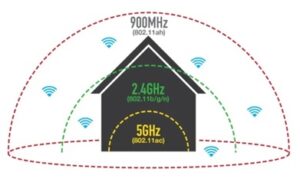
The Long Range, ultra-low power WiFi networks in sub 1 GHz licence-exempt bands.
As technology continues to evolve, the security industry consistently seeks new ways to enhance surveillance systems. One of the most exciting developments in this field is the emergence of WiFi HaLow, a low-power, long-range version of WiFi, officially known as IEEE 802.11ah. WiFi HaLow (pronounced “Halo”) is making waves across various sectors, but its impact on video surveillance systems is particularly noteworthy. In this article, we’ll delve into the benefits of WiFi HaLow for CCTV applications, its key features, and how it addresses the evolving needs of modern security infrastructures.
WiFi HaLow is an innovative technology designed to provide long-range, low-power connectivity ideal for IoT applications, and which was specifically designed for long-reach, battery-powered IoT applications. It has far greater reach than conventional Wi-Fi due to several factors.
Unlike traditional WiFi, WiFi HaLow operates in the sub-1 GHz frequency band, offering extended range and improved penetration through walls and obstructions. With its ability to connect thousands of devices, and apart from its advantageous usage for connecting CCTV cameras, Wi-Fi HaLow is poised to transform various sectors, from smart cities and agriculture to logistics and healthcare.
New Wi-Fi HaLow devices are designed to meet the growing needs of various industries and applications, including:
- Smart City Solutions: Enhancing urban living with smart lighting, parking, and waste management systems.
- Smart Building Solutions: Improving automation in buildings with accurate people counting and enhanced coverage.
- Smart Retail: Enhancing customer experience and engagement with valuable insights.
- Agricultural Applications: Revolutionising farming with remote monitoring and precision agriculture tools.
- Logistics and Asset Tracking: Ensuring efficient and secure tracking of assets and inventory.
- Healthcare Innovations: Improving patient care with remote monitoring and telemedicine solutions.
WiFi Halow and Video Surveillance
Security camera systems offering 24/7 real-time monitoring have become one of the most effective ways to tackle security challenges across public and private sectors. However, studies reveal that 75% of surveillance failures stem from network issues like poor connections and lost signals, especially in the growing home market where smart cameras are increasingly used.
Security cameras significantly reduce the risk of break-ins, making homes with these systems safer. It’s no surprise that 20% of U.S. homes now have security cameras, with the market projected to grow by 18% annually through 2030.
Beyond security, cameras can document natural disasters for insurance claims and may even lower premiums. Some models offer features like fire detection, sending early warnings for smoke, heat, or carbon monoxide. As these systems become integrated with home automation, they enable smarter, more efficient living.
Wireless CCTV systems have surged in popularity due to easy installation and flexibility. While traditional WiFi cameras offer convenience, they are limited by range and power consumption. WiFi HaLow overcomes these challenges, offering a more efficient solution.
The wireless home security camera market, driven by wired, wireless, and wire-free options, is expected to reach $25 billion by 2030, according to Global Market Insights Inc.
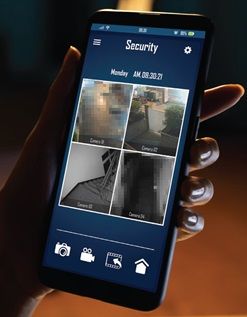 Wired Cameras: These transmit their video through a wire to a main hub. They also receive their power from a wire, from either a mains outlet or Power over Ethernet (PoE). These cameras are typically installed by professionals and may use local or cloud storage for video footage, offering clear video and audio signals. However, they require wiring that can be costly to install and cumbersome to hide. This limits where they can be installed and makes them difficult to move. Often it is difficult or impossible to retrofit existing buildings with wired cameras.
Wireless Cameras: These use a wireless data link to transmit footage. The wireless link can be Wi-Fi or cellular. Due to the large cost of connecting devices via cellular, a Wi-Fi link is usually used. Although the data link is wireless, these cameras still require a power cable to be plugged into an outlet.
Wire-free Cameras: These have the same characteristics as wireless cameras but do not use any wires at all. They run on removable or rechargeable batteries and upload their footage to the cloud or a local storage drive. They offer a clean, simple installation, making them a good option for renters, as they are easy to set up and remove.
Benefits of Wi-Fi Certified HaLow
Wi-Fi HaLow differs significantly from the conventional Wi-Fi we’re familiar with, offering a distinct advantage in range, especially for CCTV systems.
Extended Range for Surveillance Coverage
Wi-Fi standards like Wi-Fi 4, 5, and 6 operate at higher radio frequencies—2.4 GHz, 5 GHz, and 6 GHz, respectively. The higher the frequency, the shorter the distance the signal can travel in open spaces. In contrast, Wi-Fi HaLow operates in the sub-GHz range (902 MHz – 928 MHz in the U.S.), allowing signals to travel much farther due to the lower frequency.
For security cameras, this means Wi-Fi HaLow cameras can transmit video over significantly greater distances than Wi-Fi 4, 5, or 6 cameras, which typically lose connection after a few hundred metres. Wi-Fi HaLow’s range, which extends up to 1 kilometre, makes it ideal for covering large properties or outdoor spaces without the need for additional signal boosters or network infrastructure. This is particularly beneficial for large commercial properties like warehouses, factories, and malls, residential complexes that require perimeter security, and agricultural or rural settings where securing vast expanses is crucial.
This extended range simplifies the deployment of outdoor surveillance cameras and ensures that even remote areas of a property are adequately covered.
Improved Signal Penetration for Indoor and Outdoor Security
Sub-GHz signals have a much better ability to penetrate objects like walls, windows, and doors compared to conventional Wi-Fi. As a result, Wi-Fi HaLow signals are much less impacted by building structures and can easily reach outdoor areas.
 Wi-Fi HaLow’s capacity to pass through obstacles such as walls, trees, and other barriers allows it to maintain a strong, consistent signal even in difficult environments. Traditional Wi-Fi cameras often experience degraded signal quality or connection loss due to thick walls or multiple floors within a building, which can disrupt video transmission. Wi-Fi HaLow resolves this issue by providing a stable connection, enabling continuous surveillance, even in multi-story buildings or densely constructed areas. This advantage allows security teams to monitor feeds without concerns about network interruptions or the need for extra hardware like extenders or repeaters.
Lower Power Consumption for Remote Cameras
Another challenge with traditional WiFi cameras is the power consumption. Cameras running on traditional WiFi tend to consume more power, which can be problematic in remote locations or where battery-powered systems are preferred.
WiFi HaLow’s low-power capability makes it ideal for battery-operated CCTV systems, allowing cameras to run for extended periods without requiring frequent maintenance or battery replacements. This feature is particularly useful for cameras installed in hard-to-reach areas, such as high walls, rooftops, or secluded outdoor spaces.
Cost-Effective and Scalable Surveillance Solutions
Security installations in large complexes often require a significant number of cameras to ensure full coverage. The scalability of WiFi HaLow allows a single access point to connect thousands of devices, making it an ideal solution for large-scale deployments. This translates into lower installation and operational costs since fewer network devices are needed to cover vast areas.
Moreover, the extended range and reliability of the HaLow signal mean that fewer access points are required to cover the same area compared to traditional WiFi. This results in lower infrastructure costs and reduced maintenance, making WiFi HaLow a more cost-effective option for expansive security installations.
Less Congested Frequency Range
The RF frequencies that conventional Wi-Fi operates at are typically very congested with high levels of interference. 2.4GHz is used by Wi-Fi, Bluetooth and microwave ovens resulting in high levels of interference for any cameras trying to use a 2.4GHz Wi-Fi link. The 5 and 6GHz Wi-Fi technologies suffer less congestion, but the range of 5 and 6GHz is less than that of 2.4GHz (due to their higher operating frequencies). The sub-GHz range of WiFi Halow is relatively less congested.
Narrowband OFDM Channels
Wi-Fi HaLow utilises narrower channel bandwidths than conventional Wi-Fi. The narrower the channel bandwidth the further RF signals can travel. Wi-Fi HaLow can use 1MHz channels whereas the lowest channel bandwidth that conventional Wi-Fi can use is 20MHz. Orthogonal Frequency-Division Multiplexing (OFDM) is a data transmission technique that’s commonly used in wireless communication to increase efficiency and capacity. It splits a single information stream into multiple narrowband subchannels, or subcarriers, instead of using a single wideband channel. This allows multiple bits to be sent at the same time, or in parallel, instead of sequentially.
Enhanced Security Protocols
Given that WiFi HaLow is based on the IEEE 802.11 standard, it benefits from the latest advancements in WiFi security protocols, including WPA3 encryption. This ensures that the data being transmitted between cameras and central monitoring systems is secure and protected from unauthorised access or hacking attempts.
In addition, the ability to integrate with existing IP-based security systems allows security teams to deploy WiFi HaLow-enabled cameras alongside traditional cameras, creating a hybrid system that maximises coverage and flexibility without compromising on security.
As security systems shift toward smart, interconnected IoT networks, WiFi HaLow is set to transform wireless CCTV systems with its long range, low power use, strong signal penetration, and scalability. These features make it ideal for surveillance, whether in small residential areas or large commercial and industrial properties. WiFi HaLow will be crucial in providing efficient, reliable, and cost-effective solutions. Whether upgrading an existing CCTV setup or installing a new one, WiFi HaLow offers a forward-looking solution to modern security challenges.
With this technology, the future of CCTV is smarter, more connected, and more efficient than ever.