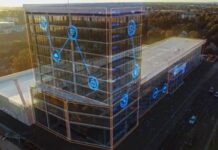



Physical security has long relied on a patchwork of technologies. CCTV, access control, intrusion detection, building management systems, each more capable than the last, yet rarely working in tandem. Digital twins are changing that. By creating a unified, living replica of a facility’s physical and operational reality, they give security leaders a single intelligent view for risk management, resilience planning, and real-time decision-making.
A digital twin is a dynamic virtual model of a physical environment, continuously fed by data from the real world. Unlike a static floor plan or 3D model, it reflects a facility’s current state, pulling live input from cameras, access control devices, IoT sensors, fire systems, environmental monitors, and other operational technology.
A real-time security command platform
Within a security operation, a digital twin functions as a live command dashboard. Personnel can see the exact status of doors, cameras, alarms, occupancy, and critical infrastructure across a campus, industrial site, airport, hospital, or corporate facility, all in one place.
If someone attempts to access a restricted area, the twin can instantly surface the location, nearby camera feeds, access history, guard positions, and evacuation routes. Instead of toggling between disconnected platforms, operators get one coherent picture, and cut response time accordingly.
Beyond monitoring: simulation and prediction
Perhaps the greatest strength of digital twins is their ability to model scenarios before they happen. Teams can rehearse emergency response plans, evacuations, perimeter breaches, fire events, or infrastructure failures entirely within the virtual environment, no disruption to live operations required.
These simulations expose vulnerabilities, sharpen guard deployment, improve camera coverage, and test whether existing policies actually hold up under pressure. The result is a shift from reactive security to proactive design.
Layer in AI, and the twin becomes predictive: flagging unusual crowd movement, repeated access anomalies, equipment degradation, or environmental conditions that could signal trouble ahead, often before a human operator would notice.
Integration is the real value
The deeper value of a digital twin isn’t any single feature, it’s integration. Most organizations already generate vast amounts of security and operational data; the problem is that it’s scattered across incompatible vendors and systems. A well-built twin consolidates:
Video surveillance and analytics
Access control and identity management
Visitor management
Fire and life safety systems
Building management systems
Environmental sensors
Asset tracking
Emergency communication systems
That consolidation lets security operations centers make faster, better-informed calls, and collaborate more naturally with facilities, safety, and business continuity teams who were previously working from different data entirely.
The adoption challenge
Digital twins are not plug-and-play. Interoperability, data quality, cybersecurity, and implementation cost remain real obstacles, and building an accurate twin demands standardized data integration and ongoing governance.
Privacy deserves particular attention. Twins that incorporate facial recognition, occupancy tracking, or employee movement data must be built with data protection compliance from the outset, not bolted on afterward.
How security managers can actually put this to work
The organizations getting real value from digital twins tend to treat them as a discipline, not a dashboard purchase. A few practical angles worth considering:
Start with your highest-consequence scenarios, not full facility coverage
Trying to twin an entire campus on day one is how these projects stall. Pick the two or three failure modes that would hurt most, an unauthorized entry into a server room, a fire in a high-occupancy area, a perimeter breach at a loading dock, and build the twin around those first. A narrow, well-instrumented twin that actually gets used beats a comprehensive one that never leaves the pilot phase.
Use simulation as a budget-justification tool, not just a training exercise Running “what if” scenarios — adding a camera here, repositioning a guard there, changing a badge-access rule, lets managers show, with data, which investments actually reduce exposure before spending a dollar. That reframes security budget conversations from “trust me, this helps” to “here’s the modeled impact.”
Treat data quality as a security control in its own right
A twin is only as trustworthy as its inputs. Sensors that drift, cameras with blind spots, or stale access-control feeds don’t just create blind spots in the physical sense, they create false confidence in the twin itself. Auditing sensor health should be part of the same governance process that reviews physical patrol routes.
Build the privacy and access model before the twin goes live, not after
Because a twin often centralizes movement, occupancy, and identity data that used to live in separate systems, it can quietly become the most privacy-sensitive system on the property. Deciding early who can see what, and logging that access, avoids having to retrofit compliance under pressure later.
Use it to break down the silo between security and facilities/safety teams
One of the more underrated benefits is organizational, not technical: when security, facilities, and business continuity teams are looking at the same live model instead of separate systems, response coordination during an actual incident improves simply because everyone is arguing from the same picture of reality.
The honest caveat: a digital twin doesn’t reduce risk by existing. It reduces risk when it changes a decision, a guard gets repositioned, a door schedule gets tightened, an evacuation route gets redrawn, because of something the simulation revealed. Managers who measure success by “did this change what we did” rather than “did we deploy the technology” will get far more out of it.
Some use cases
The theory is well ahead of adoption, but there are genuine deployments to point to — mostly clustered in aviation, major venues, and smart-city infrastructure, where the consequences of a security failure are severe and the funding for large-scale sensor networks already exists.
Digital twins are already being deployed at scale across airports, major venues, and critical infrastructure. Singapore’s Changi Airport uses digital twins for real-time simulation, automation, and predictive maintenance, achieving a 15% reduction in equipment downtime and a 20% improvement in queue management, while Amsterdam Schiphol integrates over 80,000 sensors for asset monitoring and capacity planning. The Paris 2024 Olympics created digital twins for every venue, tracking about 60,000 assets and supporting crowd and logistics management, and SoFi Stadium uses a live operational twin for facility management. Singapore’s Virtual Singapore and New South Wales’ state-level digital twin platform also support city-scale security, crowd-dispersion, and emergency-response planning.
The common thread across these examples: the most mature deployments aren’t standalone “security twins.” They’re broader operational twins, built primarily for capacity planning, maintenance, or event logistics, into which security monitoring, incident response, and emergency simulation were layered as one use case among several. That’s a useful signal for any manager scoping a first project: security-specific ROI is easier to justify when the twin also pays for itself through operational efficiency elsewhere in the building or campus.
Where this is heading
As AI, IoT, and analytics mature, digital twins will move beyond visualization into autonomous security intelligence, supporting predictive maintenance, automated threat detection, and coordinated emergency response at enterprise scale.
For critical infrastructure, financial institutions, healthcare systems, manufacturing plants, and smart campuses, this isn’t a minor upgrade. It’s a new operating model, one where security is continuously monitored, simulated, and optimized, and where organizations can see a crisis coming instead of just responding to one.