



For nearly two decades, India’s CCTV industry grew on a model that was remarkably simple and surprisingly resilient. Hardware was imported, products were assembled or rebranded locally, and competition was driven largely by price. Cameras became increasingly affordable, installations expanded rapidly across cities, factories, banks, schools, housing societies and commercial buildings, and the industry evolved into one of the largest surveillance markets in the world. Yet behind that growth lay a structural weakness. A significant share of the technology, components and value creation remained outside India.
That era is now coming to an end.
The Indian surveillance industry is entering a phase that can only be described as a ‘great reset’. The implementation of the STQC Essential Requirements (ER-01) framework has fundamentally altered the manufacturing and supply chain architecture of the CCTV market, while artificial intelligence is transforming surveillance from a passive recording tool into an active intelligence platform. Together, these two forces are changing not only what products are sold, but also who creates value, who wins market share, and what the industry itself is becoming.
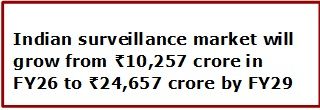 The latest ELCINA–Counterpoint assessment projects that the Indian surveillance market will grow from ₹10,257 crore in FY26 to ₹24,657 crore by FY29, representing one of the fastest growth trajectories in the Indian electronics sector. However, the most important insight is not the 34 percent CAGR. It is the fact that the industry is undergoing a structural transformation. The value chain is shifting from imported hardware to certified domestic manufacturing, from analog systems to AI-enabled IP surveillance, and from standalone cameras to integrated surveillance ecosystems that combine hardware, software, analytics and command-and-control capabilities.
This is not merely a bigger CCTV market. It is a fundamentally different industry.
STQC changed the rules of the game
Every industry has a moment when regulation changes the basis of competition. For India’s surveillance sector, that moment arrived with the STQC framework.
 For years, a large portion of the market operated on imported hardware, particularly from China. White-labelled cameras were imported, rebranded under Indian names, and sold through a vast network of distributors and system integrators. Some leading brands of the erstwhile era were doing exactly this, before they began manufacturing locally in the new era. Even products marketed as Indian often contained a very high proportion of imported content. Manufacturing was limited, supply chains lacked transparency, and price remained the dominant competitive weapon.
The STQC framework changed that equation by introducing requirements related to trusted sourcing, firmware traceability, cybersecurity, product certification and manufacturing compliance. Suddenly, cameras could no longer be treated as generic electronic devices. They became part of the country’s critical digital infrastructure.
The immediate impact was disruptive. Many smaller brands that depended heavily on imported white-label products found it difficult to comply with the new requirements. Supply chains had to be reconfigured, manufacturing processes redesigned, and certification capabilities developed. The industry faced a period of uncertainty, delays and adjustment. Yet the long-term consequences have been far more significant than the short-term disruption.
The report indicates that domestic manufacturers with stronger production capabilities have emerged as major beneficiaries of the transition. Companies that invested in local manufacturing, engineering, testing and product development have been able to expand capacity and strengthen their market positions. Electronics manufacturing service providers have also become increasingly important, supplying printed circuit boards, imaging modules, housings, power systems and other components that are now being produced within India.
The significance of this shift extends beyond surveillance. STQC has effectively transformed a security compliance requirement into an industrial policy catalyst. It has encouraged domestic manufacturing, deeper local value addition, and greater control over supply chains. The CCTV industry is moving away from a trading model and towards a manufacturing and technology model.
For distributors and system integrators, the implications are equally profound. Product selection is increasingly influenced by certification status, cybersecurity compliance, software capability and long-term support rather than simply by acquisition cost. The market is becoming more structured, more regulated and significantly more quality-driven.
Infrastructure is rewriting the demand story
One of the most striking findings of the report is that the next phase of surveillance growth is being driven primarily by infrastructure investment rather than traditional security demand.
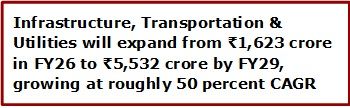 Railways, metro systems, highways, airports, ports, industrial corridors and urban command-and-control centres are creating surveillance requirements at a scale that did not exist a decade ago. The report identifies Infrastructure, Transportation & Utilities as the fastest-growing vertical, expected to expand from ₹1,623 crore in FY26 to ₹5,532 crore by FY29, growing at roughly 50 percent CAGR and overtaking the Government & Public Safety segment.
This is a critical shift because infrastructure surveillance is fundamentally different from conventional CCTV deployment.
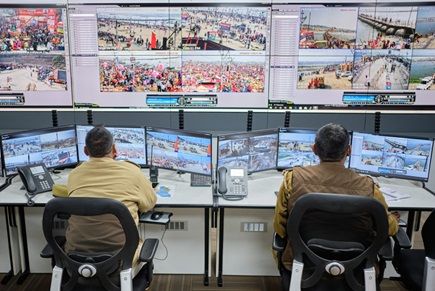 A housing society may require a few dozen cameras. A railway network may require tens of thousands. A metro corridor demands integrated surveillance across stations, platforms, depots and rolling stock. A national highway network requires continuous monitoring, incident detection and traffic analytics across hundreds of kilometres.
These deployments require IP-based architectures, centralized monitoring, AI analytics, cybersecurity compliance, high-capacity recording systems and long-term service support. They are not camera projects; they are surveillance platforms.
As public infrastructure becomes increasingly digital, surveillance is becoming embedded within the operational architecture of transportation networks, utilities and urban infrastructure. Cameras are evolving into connected sensors that support traffic management, operational efficiency, emergency response and public safety.
The growth of infrastructure surveillance is therefore reshaping the entire industry. It is increasing project sizes, extending service contracts, accelerating software adoption and favouring companies capable of delivering integrated end-to-end solutions.
AI is becoming the real product
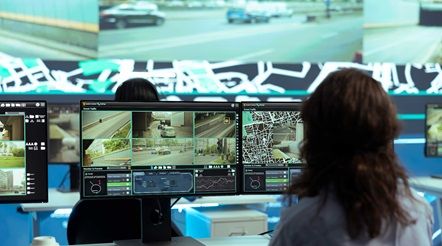 The second force reshaping India’s surveillance industry is artificial intelligence, which is fundamentally changing the purpose and value of surveillance systems. For decades, CCTV networks were designed primarily to record events for later investigation, but that model is becoming increasingly inadequate in an environment where the real challenge is not the number of cameras installed, but the sheer volume of video they generate. A city command centre may receive feeds from thousands of cameras, a large industrial complex may operate hundreds of cameras across multiple facilities, and a transportation network may generate continuous video streams across extensive infrastructure, creating an overwhelming amount of information that no human operator can monitor effectively in real time. AI has therefore evolved from being an optional feature to becoming an operational necessity.
AI is enabling surveillance systems to automatically detect intrusions, abandoned objects, perimeter breaches, traffic violations, crowd build-ups, violence, vehicle movements, occupancy levels, queue lengths and a wide range of other operational events. By identifying exceptions and generating intelligent alerts instead of requiring operators to watch video continuously, AI is transforming both the efficiency and the economics of surveillance, where the value of a camera is increasingly determined not by its image quality or price alone, but by the intelligence it can generate and the decisions it can enable.
This shift has important implications for the hardware side of the industry as well. AI-enabled cameras and recorders require significantly greater processing power, memory and storage capacity, increasing the semiconductor content of surveillance systems and making component costs a much more important factor in product pricing. At the same time, the global semiconductor market is undergoing a major realignment as manufacturers increasingly prioritize high-bandwidth memory (HBM) and advanced chips for AI data centres, leading to shortages and rising prices for conventional memory and storage components used across the electronics industry. As the cost of memory chips and other critical components continues to rise, surveillance manufacturers will face increasing pressure to optimize hardware design, edge processing capabilities and storage efficiency, further accelerating the industry’s move toward intelligent, software-driven surveillance platforms.
The report also highlights the rapid growth of video management systems, AI-powered analytics platforms and integrated command-and-control software. These technologies are becoming essential components of large surveillance deployments. AI-enabled edge cameras are processing data locally, reducing bandwidth requirements and enabling faster decision-making. Intelligent NVRs are consolidating multiple video streams and supporting advanced analytics.
The industry is moving from monitoring to intelligence.
 This is also creating a significant opportunity for Indian software companies. A growing ecosystem of domestic video analytics and surveillance software providers is developing platforms designed for Indian operating conditions, local infrastructure requirements and data-localization needs. These companies are capturing value that previously flowed primarily to multinational software vendors.
 In the next phase of industry growth, software will become increasingly important not only because it generates higher margins, but because it creates recurring revenue through licensing, analytics subscriptions, cloud services and system integration.
The IP migration is accelerating
Another major structural trend identified in the report is the migration from analog surveillance to IP-based intelligent surveillance.
Analog cameras and DVRs are not disappearing immediately, but they are entering a phase of managed decline. Their demand is increasingly linked to legacy replacement and cost-sensitive installations rather than new investment.
The report suggests that the combined revenue share of IP cameras and higher-capacity NVRs will rise dramatically during the forecast period. Virtually all major government and infrastructure projects now specify IP-based systems with analytics capabilities.
This matters because IP surveillance dramatically expands the scope of what a surveillance system can do.
IP cameras support higher resolution, remote management, network integration, edge processing, cloud connectivity and AI analytics. They can integrate with access control, building management systems, traffic management platforms and enterprise security operations centres.
The migration to IP also increases demand for networking infrastructure, storage, cybersecurity, software integration and managed services. As a result, the industry’s value is shifting from hardware volume to solution complexity.
Vendors capable of providing cameras, NVRs, video management software, analytics and integration services are likely to capture a disproportionate share of future market growth.
The localization story has an important limitation
 While the report presents a strong manufacturing story, it also contains a critical strategic warning. India has significantly increased manufacturing localization, but it has not yet achieved technology localization.
The report estimates that an India-assembled surveillance camera still remains more than 95 percent dependent on imported semiconductor content. The most critical components, including camera SoCs, image sensors, Wi-Fi chipsets and memory devices, continue to be sourced primarily from Chinese and Taiwanese suppliers. Now, this creates a paradox!
India has localized assembly, packaging, mechanical components and portions of the electronics manufacturing process. However, the core semiconductor technology that determines performance, AI capability, cybersecurity and system functionality remains overwhelmingly imported.
For a surveillance industry increasingly linked to national security, trusted infrastructure and digital sovereignty, this remains the most important unresolved challenge.
The next phase of industry development will require progress in semiconductor packaging, imaging modules, embedded systems, edge AI processors and domestic design capabilities. Manufacturing localization has begun. Technology localization is still a work in progress.
A new competitive order
The surveillance reset is also redefining competition.
The previous market rewarded companies that optimized sourcing, pricing and channel distribution. The emerging market rewards companies that combine certified manufacturing, AI software, cybersecurity compliance, system integration and lifecycle support.
Government and enterprise buyers are increasingly evaluating solutions based on operational outcomes rather than camera counts. Tenders are beginning to specify incident detection, crowd management, traffic analytics, perimeter intelligence and command-centre integration.
This favours companies with integrated portfolios and stronger engineering capabilities.
It also creates opportunities for collaboration across the ecosystem. Manufacturers need software partners. Software companies need hardware integration. System integrators need cybersecurity expertise. Distributors need technical capability. The industry is becoming more interconnected and more technology-intensive.
 Perhaps the most important change is that surveillance is increasingly being justified by business value rather than only by security value.
Manufacturers are using AI for process monitoring and workplace safety. Retailers are using analytics for customer flow and operational efficiency. Banks are adopting centralized e-surveillance. Logistics companies are integrating surveillance with gate automation and inventory management. Surveillance is becoming an operational technology.
The next decade belongs to intelligence
The Indian CCTV industry is no longer simply selling cameras. It is building a surveillance ecosystem that combines trusted manufacturing, AI analytics, software platforms and digital infrastructure.
STQC has changed who can participate in the market. Infrastructure investment has changed where demand is coming from. AI has changed what surveillance systems are expected to deliver. Together, these forces are rebuilding the industry from the ground up.
The companies that will lead the next decade will not necessarily be those that sell the cheapest cameras. They will be those that manufacture trusted products, develop intelligent software, integrate complex systems and create actionable intelligence from video data.
The great surveillance reset is therefore not merely about replacing imported hardware with locally manufactured hardware. It is about transforming surveillance from a low-margin electronics business into a high-value intelligence industry.
The camera is no longer the destination. It is the beginning of the intelligence chain.