


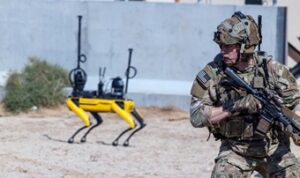
According to a new Frost & Sullivan analysis, Human-Machine Integration/Manned–Unmanned Teaming (MUM-T), Global, 2025–2027, the rapid convergence of artificial intelligence, autonomy, and secure networked communications is transforming modern military doctrine and accelerating the shift toward multi-domain operations.
Global spending on MUM-T is projected to grow from approximately $5.0 billion in 2024 to $7.6 billion by 2027, reflecting a compound annual growth rate (CAGR) of 15.2%, as defence organisations prioritise force multiplication, survivability, and operational agility.
“Manned–unmanned teaming is moving decisively from experimentation into scalable deployment,” said Avi Kalo, Global Aerospace & Defence Director at Frost & Sullivan. “What differentiates the current phase is the integration of AI-enabled autonomy, open architectures, and real-time human oversight – allowing armed forces to coordinate assets across air, land, and maritime domains with unprecedented speed and flexibility.”
Once limited to niche trials, MUM-T has emerged as a core pillar of next-generation force modernisation, enabling manned platforms to collaborate seamlessly with unmanned aerial, ground, and maritime systems. These capabilities support missions ranging from intelligence, surveillance, and reconnaissance (ISR) and electronic warfare to strike operations and logistics, while reducing risk to human operators.
The study highlights that leading defence organisations – particularly in North America and Europe – are accelerating adoption through flagship programmes such as collaborative combat aircraft, future vertical lift, and naval unmanned teaming initiatives. At the same time, Asia-Pacific and Middle Eastern markets are expanding MUM-T investments in response to regional security dynamics and evolving threat environments.
Frost & Sullivan identifies several converging forces underpinning the market’s expansion:
● Advances in AI and autonomy, enabling higher levels of interoperability and reduced cognitive burden on operators
● Modular open systems architectures (MOSA) that streamline integration and future-proof platforms
● Rising defence budgets and fast-track procurement, particularly for adaptable, software-defined capabilities
● Cross-sector collaboration between traditional defence primes and agile defence-tech innovators
However, Kalo also notes persistent challenges, including cyber security vulnerabilities, integration complexity, and ethical and legal considerations surrounding human oversight and autonomous decision-making.
Kalo continues: “Our analysis identifies significant growth opportunities across procurement, research and development, and defence-tech collaboration, as governments and industry partners seek to accelerate innovation cycles, reduce costs, and operationalise MUM-T at scale. Upgrading legacy platforms, investing in AI-driven mission software, and expanding testing and simulation environments are expected to be key areas of focus over the next three years.
“As geopolitical tensions intensify and operational environments become more contested, MUM-T is no longer optional – it is strategic,” he concludes. “Defence organisations that align doctrine, technology, and partnerships around human–machine teaming will be best positioned to achieve sustainable operational dominance.”