

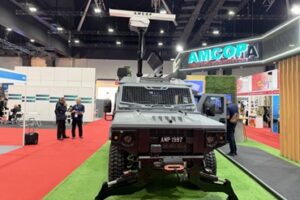
Malaysian company AMCOP has unveiled its MSU MK‑III mobile surveillance radar vehicle at the DSA & NATSEC Asia exhibition, signalling a new step in the country’s ambition to field indigenous, high‑mobility air and surface surveillance capabilities. Installed on a rugged tactical vehicle chassis and featuring a compact, mast‑mounted radar suite, the platform combines advanced sensors, secure communications and mission‑proven automotive components to provide 24/7 border security, base protection and coastal or convoy overwatch in demanding tropical conditions.
Designed from the outset for rapid deployment and networked operations, the MSU MK‑III gives military and security forces a deployable, stand‑alone sensor node that can plug directly into existing command‑and‑control architectures
The MSU MK‑III (Mobile Surveillance Unit) is configured as a self-contained unit to move with manoeuvre forces or to operate as a semi‑static sensor hub feeding higher‑echelon headquarters. Its mast‑mounted radar delivers long‑range detection of low‑flying aircraft, unmanned aerial systems and ground targets, while the elevated sensor head improves line‑of‑sight performance over broken terrain, urban clutter and dense vegetation typical of Southeast Asia.
By integrating radar, processing, power generation and communications on a single carrier, AMCOP reduces the logistic footprint and deployment time compared with trailer‑based legacy solutions, a key advantage for dispersed border posts and expeditionary contingents. In peacetime, the same configuration can be redeployed to support critical infrastructure protection, coastal approaches surveillance and major‑event security.
When on the move the radar is lowered on top of the vehicle and is protected by a cover, which opens up to allow raising the 6-foot-long X-band antenna up to 6 metres. At the rear right of the vehicle a second hydraulic mast allows raising the electro-optic sensor package up to 4 metres height. The modular layout offers growth margin for future integration of further sensors, additional communications fits, or specialist mission equipment, ensuring the MSU MK‑III can evolve with user requirements and emerging threats.
The vehicle is based on a commercial‑off‑the‑shelf platform adapted for surveillance missions, balancing cost‑effectiveness with military‑grade robustness and ease of support. Structural and suspension reinforcements support the additional weight and dynamic loads associated with the mast, shelter and mission equipment, while maintaining on‑road and off‑road mobility sufficient to follow front‑line formations and access austere sites. Ground clearance, approach and departure angles are tuned for operation on laterite tracks, plantation roads and semi‑urban terrain, with stability prioritised to ensure safe mast operation when the radar is elevated, six metres being its maximum elevation. This combination allows the MSU MK‑III to reach and sustain observation points that might be inaccessible to heavier platforms.
An 8 kWh smart power station working in concert with the vehicle alternator provides electricity to all subsystems, an intelligent power management tier-based load priority system ensuring mission-critical systems such as the radar and electro-optical sensors remain uninterrupted under all conditions over prolonged periods.
At the core of the vehicle is the mast‑mounted radar, engineered for quick deployment and effective performance in cluttered, high‑humidity environments. The telescopic mast can be raised to operational height in a matter of minutes, significantly improving radar coverage over terrain undulations, buildings and tree lines, while allowing the carrier to remain behind cover or within a protected perimeter. When stowed, the mast and antenna fit within the road‑legal envelope, easing movement on public roads and reducing visual signature. Stabilisation and locking arrangements minimise mast deflection and vibration, preserving tracking accuracy under typical regional wind conditions.