

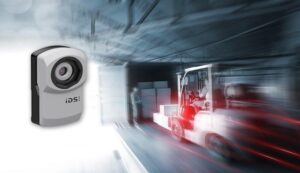
CANCOM has developed a camera-based system to document forklift loading automatically, recording each stage without interrupting warehouse work. An IDS uEye XC autofocus camera captures images, which artificial intelligence (AI) technology from DENKweit analyses to identify relevant information and create a traceable record of the process.
Mounted on the forklift cabin, the camera continuously records the area ahead as the vehicle moves. The system captures the delivery note and the loading sequence, including manoeuvring, collecting and placing each pallet, and securing the load once the forklift is parked.
Automated recording removes the need for drivers to stop and document each step manually. The resulting image data provides a consistent record of the process, with relevant information linked to the specific delivery tour.
The camera sends images to an on-board vehicle terminal through a standard USB Video Class (UVC) interface, which does not require additional drivers. The data is then sent to a local AI server for analysis in real time. An AI image-classification stage assesses the content and relevance of each frame, filtering out more than 99 per cent of captured images before further processing.
For the remaining images, models from DENKweit’s DENKnet system combine object recognition with optical character recognition (OCR). They identify delivery notes and pallet structures, read the tour number and use it to organise relevant images centrally. The system can also count the pallets in an image and determine their dimensions.
The uEye XC camera adjusts its focus automatically to capture both close-up documents and the wider loading area. “For capturing a delivery note, thefocus is set to a distance of around 35 centimetres. For documenting the loading process, however, the field of view is between 2 and 3 metres,” explains Thomas Fuchs, Team Leader AIoT at CANCOM. “This ensures sharp, usable images in every situation, even when lighting conditions vary.”
The camera has a 13-megapixel sensor, automatic white balance and colour correction, as well as adjustable brightness, contrast and sharpness settings. Its UVC connection allows it to operate like a standard webcam. Used with Windows IoT on the vehicle terminals, it can be detected automatically and managed through a central device management system.
CANCOM’s solution uses containerised DENKweit AI models, which can run in Kubernetes environments and scale from edge devices to data centres. GPU acceleration is available where needed. Initial models can be developed from relatively few training images, with performance improving as the quality and variety of data increase.
According to CANCOM, learning-based methods can reduce the development work involved compared with traditional machine vision systems, replacing complex rule-based processes with models that are quicker to implement and adapt. Integrated GPU solutions can provide sufficient computing power for many applications.
“AI image processing opens up a much broader range of applications for camera-based solutions and makes their use economically viable,” Fuchs said. He added that projects which previously required investments well into six figures and several months of development can now be completed within weeks at lower cost.
CANCOM plans to apply the technology in further projects. Potential uses extend beyond logistics to other industries where processes need to be more efficient, transparent and traceable.