


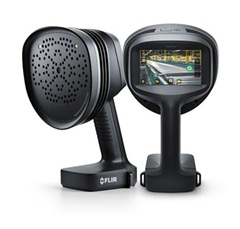
Flir has launched the Si2-Series of advanced acoustic imaging cameras, engineered to identify unusual sounds indicative of early bearing failure. These portable, unobtrusive cameras can detect sounds from a distance, ensuring operator safety by facilitating inspections without necessitating operational shutdowns.
The Flir Si2-Series cameras boast a 12 MP system that captures sound and displays it on a 5-inch, 1280 × 750 high-definition colour screen, delivering clear, real-time feedback.
Designed to function as an effective early warning system for preventative maintenance, these advanced devices not only identify anomalies in bearings and gearboxes but also locate leaks in compressed air or gas systems and detect partial discharges in electrical systems. This capability not only leads to cost savings but also promotes health and safety in potentially dangerous settings.
Acoustic imaging technology provides a critical early warning mechanism for detecting potential issues in wind turbines, helping keep them operational and efficient.
Wind turbines, often sited in remote and hard-to-access locations, present unique logistical challenges for construction and maintenance, especially for offshore sites. Even land-based turbines located in isolated mountainous areas designed to capture maximum wind can pose difficulties for maintenance teams.
Within the turbine structure, the nacelle—which houses critical components such as the gearbox—must be accessed through a confined tower space, making maintenance and replacement of heavy components cumbersome. It is, therefore, crucial for wind farm operators to adopt measures that enhance nacelle component reliability and durability.
A key component in wind turbines is the gearbox, which is crucial for translating the slower rotational speed of the blades to a higher speed suitable for electricity generation.
Planetary gearbox systems, valued for their efficiency, are common due to their ability to enhance speed from the shaft. These systems, containing helical gears and multiple bearings, are not only complex but also costly.
Failure of these components could result in significant expenses, not just for parts replacement, but also due to the resulting turbine downtime and logistical hurdles in obtaining replacement parts. Hence, proactive monitoring to facilitate early detection of issues is vital. It allows operators to tackle problems before they worsen, thereby reducing downtime and prolonging the turbine’s operational life.