


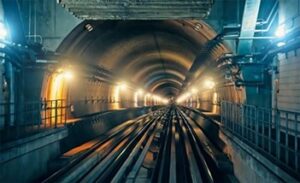
Train derailments and accidents cost both money and lives. That is why companies and governments across Europe are keen to make transport tunnels safer.
“Modern laser detection sensors can see in complete darkness, strong sunlight, and artificial light, and are unaffected by the train’s bright headlights, reflections on tunnel walls, or other trains passing through”, says Eelko Griepink, Area Sales Manager for Benelux and Northern Europe at Optex.
Tunnels are a vital part of Europe’s transport infrastructure, connect communities, and contribute to the overall economy and competitiveness of the single European market. And as tunnels have become more complex, so too has the technology required to protect them, according to Eelko Griepink.
More transport systems are being built in underground tunnels each year in order to reduce the effect of noise and pollution on people’s lives and the environment. And these tunnels are getting longer and deeper. For instance, the tunnel from Randabreg to Bokn in Rogaland County, Norway, is 26.7km long and 392 metres deep under water, and the Fehmarnbelt tunnel between Germany and Denmark, once complete in 2029, will be the world’s longest underwater tunnel and create a direct corridor from Northern to central Europe.
“Without these tunnel networks, economies may falter. Railway incidents, for example, can be costly. In December 2023, a fully loaded iron ore train derailed at Vassijaure Station near the Swedish-Norwegian border on the Malmbanen line, a critical route for Sweden’s largest mining company, LKAB. The line was not reopened until 20 February 2024, but it closed again just days later, following a second derailment, and remained closed until early March”, says Eelko Griepink.
This disruption had a significant impact, with LKAB reporting daily revenue losses of 8.8 million Euro during the closures. Similarly, when part of the Alpine network, the Mont Blanc tunnel, closed following a fire in 1990, the Italian economy lost an estimated 300 to 450 million Euro per annum until it reopened three years later.
Whilst such large-scale incidents are rare, smaller ones are not. European Railway safety statistics reveal there were 1,567 significant railway accidents in 2023 with 841 lives lost and 569 people seriously injured. Over half (58.4 per cent) of fatalities were trespassers – typically vagrants (setting up tents in tunnels), vandals, or graffiti artists, according to Eelko Griepink.
Even if there is no injury or loss of life, vandalism can cause derailments, collisions and fires, all of which are costly. In one year alone there were 3,559 acts of vandalism and graffiti on Spanish railways, of which 729 attempts were stopped. Such incidents cost Spanish Renfe roughly 25 million Euro annually, Deutsche Bahn spends 12.1 million Euro, and Brussels’ SNBC around 6 million Euro cleaning graffiti off rolling stock.
”These incidents are not as economically damaging as the Mont Blanc fire, but show that protecting the railways and the trespassers is both expensive and challenging”, says Eelko Griepink.
Accurately detecting a person in the confines of a tunnel is challenging enough by itself and is only made more difficult when several trains are using the tunnels at the same time.
For around 50 years, CCTV has been used to monitor tunnel entrances and exits. But early systems needed security teams to constantly watch between 12 to 24 camera feeds on a single screen. Thankfully, video analytics was created and overcame some of these challenges. A trespasser will instantly trigger an alert which directs the security teams to the appropriate camera feed, who can then immediately decide what action to take.
“The technology, though, has to keep evolving. Trespassers have learnt that they can go undetected by moving towards or entering the tunnel as the train is passing or deliberately alter their appearance to fool the analytics software. The heat and humidity inside tunnels can adversely affect many older technologies, and radar or microwave technology struggles to filter the noise and false alarms generated by the train, and so they fail to provide adequate detection”, says Eelko Griepink.
He points out that Optex’s Redscan sensors operate reliably at temperatures as low as -40°c and modern laser detection sensors are unaffected by humidity, temperature, or lighting conditions.
Eelko Griepink says: “Equipped with intelligent sensing analytics, the Lidar technology does not depend on visible light or thermal spectrums, which is useful when tracking a person or animal from the lit tunnel entrance to inside and further along the tracks or in the shadows. They perform remarkably well even during heavy snowfall that alters the apparent ground height and light levels.”
Tunnels located in isolated regions need accurate detection because a false alarm is costly in time and effort if security services are called out unnecessarily. More advanced detection sensors, such as Optex’s Redscan series, use dynamic event filtering to accurately identify human trespassers.
When monitoring a tunnel entrance, specific detection criteria or logic is applied to establish different detection zones, the sequence of alarm triggers, and the size of an object, which in combination can determine whether a train, a person, or a group of people is entering the tunnel.
“Redscan Lidar sensors can detect objects across eight different zones and an area of 100 metres. They can be configured to recognise objects larger or smaller than a defined size; for example, they can ignore trains while detecting people or overlook small rocks but identify boulders”, says Eelko Griepink.
If a person or group is detected, the control centre and train driver are alerted, allowing the train to slow down or stop to avoid striking a person, a large wild animal or an obstruction. Additionally, since the sensors continuously scan the area, security teams receive the precise x,y coordinates of any detected object, enabling a rapid response.
Train tracks, when cleaned, throw up a considerable amount of metal and oil into the air, which, like pollution from diesel fumes, can coat or potentially damage the cameras and sensors. Dirty cameras or sensors cannot detect intruders or incidents, so they need to be cleaned.
Eelko Griepink says: “The latest sensors from Optex feature an algorithm that continuously measures the return or reflection of the laser signal, tracking the percentage of the unit’s window that is soiled. Once a certain level of soiling is reached, security personnel are notified.”
Optex has also developed a special self-healing foil for laser sensors used in underground tunnels, which protects the laser window from dust, metal fragments, oil, and other pollutants. These sensors can reduce the frequency of security personnel’s trips to tunnels in remote locations, helping to lower operating and maintenance costs.
Eelko Griepink says: “Sensors are often adapted for different environments and various uses, so the correct choice of sensor is essential to the design of any tunnel security system.”
Designing the right security system begins with a survey of the site and an estimate of how many cameras and sensors are needed for the size of the tunnel to ensure sufficient coverage. The quality and amount of light at the openings and along the tunnel will help determine whether dynamic filtering sensors are needed because they will be unaffected by trains passing or light bouncing.
In most average European rail tunnels, for example, laser sensors are installed on both sides of the track. With larger tunnels, there is usually a third set of sensors in the middle between the tracks. Ultimately, finding the right solutions and combination of technologies that are fit for purpose will vary from tunnel to tunnel, according to Optex.
Eelko Griepink concludes: “But continued development and advancement of new technologies can only help to enhance safety and ensure Europe’s critical tunnels remain open.”