


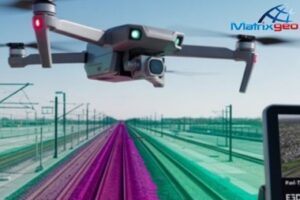
Matrix Geo Solutions Limited, a geospatial technology and engineering consultancy, has received a Letter of Acceptance from North Western Railway for project monitoring of the ongoing Luni–Samdari–Bhildi double line project.
The contract with North Western Railway, headquartered in Jaipur, involves aerial videography-based monitoring of the 271.97 km rail corridor using drone systems. The project will be executed over a period of 30 months, with a total contract value of INR 3,07,62,599.51.
As railway infrastructure projects expand in scale and complexity, the need for continuous, accurate, and data-backed monitoring has become more critical. Through drone-led aerial surveys and high-frequency data capture, the project will enable better tracking of construction progress, early identification of deviations, and improved coordination across stakeholders.
On a monthly basis, advanced UAVs equipped with high-resolution cameras and sensors will capture 4K geo-tagged video data along the alignment, with precise GPS metadata mapped to each frame. This data will be post-processed to enable change detection across the corridor, covering key construction stages such as earthwork, ballast laying, rail installation, bridge construction, and associated infrastructure development. The approach is expected to support tighter timelines, enhance on-ground safety, and bring greater transparency to project execution.
Speaking on the project win, Amit Sharma, Whole Time Director, Matrix Geo Solutions Limited, said, “This mandate from North Western Railway further expands our work in railway infrastructure projects. Corridors of this scale require continuous oversight and precise data to keep execution on track. Through UAV-led monitoring, we aim to provide clear, real-time visibility into progress, enabling faster decision-making and better coordination. We are confident in our ability to support efficient execution while maintaining strong control over timelines across the project lifecycle.”
The use of drone-led monitoring is also expected to deliver measurable efficiencies, including a reduction of approximately 50% in the need for physical site visits by senior officials, a decrease of around 25% in reporting turnaround time, and improved visibility into critical project locations through real-time drone feeds.